Finance secretary Ajay Bhushan Pandey on Sunday hinted that the government was working on another stimulus package but he refrained from giving a timeframe.

Catch all the action from the Monsoon session of Parliament, LIVE

Dealers attributed the rupee's fall to increased demand for the US currency from importers.
The stormy monsoon session of Parliament came to an end on Thursday, becoming a virtual washout and delaying legislations which could not be passed because of continuous acrimony.

The Modi administration has been unable to initiate key reforms.

The outcome is beyond the market's expectation and will be a sentimental boost, say analysts.

'The role of Parliament is to hold the government of the day, whichever party is in power, accountable for its actions, policies.' 'The amount we are wasting on Parliament is a very miniscule amount. But the cost of delay in policy-making is huge and that affects the entire nation.'
Titan was the top gainer in the Sensex pack, rising around 4 per cent, followed by HDFC, Nestle India, IndusInd Bank, UltraTech Cement and Bharti Airtel. On the other hand, Bajaj Auto, Tata Steel and NTPC were the laggards.
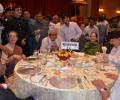
Sonia Gandhi's iftar was meant to be a powerful show of unity of Opposition parties to take on the Modi Sarkar, but that was not to be...

While seven of the suspended MPs belonged to the TMC, six were from the DMK, three from the Telangana Rashtra Samithi, two from the Communist Party of India-Marxist and one from the Communist Party of India.

Vagela could not have reached this position if Narendra Modi, who'd known him from his chief minister days, had not backed the choice.
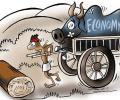
In twin blows to Indian economic revival, higher food prices drove retail inflation to a five-month high of 7.4 per cent while factory output fell for the first time in 18 months. The second consecutive month of rise in consumer price index (CPI)-based inflation will add to the pressure on the Reserve Bank of India (RBI) to again raise interest rates to tame high prices. Inflation has been above the targeted zone for the ninth month in a row and as per statute, the RBI will now have to explain to the government in writing why it failed to keep prices below 6 per cent.

Prime Minister Narendra Modi hit out at the Congress for "misusing" Parliament to stop the country's growth and hailed Samajwadi Party chief Mulayam Singh Yadav for "understanding this conspiracy" and working to end the logjam in the House.

Honest tax payers need not worry about the new black money law, says finance minister Arun Jaitley.
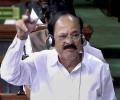
The Congress on Monday sought a discussion on the latest report of the CAG, listing alleged irregularities in Gujarat State Petroleum Corporation's KG basin gas project and forced three adjournments in Rajya Sabha in the pre-noon session demanding a response from Prime Minister Narendra Modi.

Interlinking of rivers, retrieval of Katchatheevu island and inclusion of fishermen in the Scheduled Tribes list are also listed in the memorandum.

Business activity resumption continued for the fifth consecutive week as the second wave of infections and restrictions continued getting subsided, a Japanese brokerage said on Monday. The business activity now is only 13 percentage points lower than levels observed before the onset of pandemic in March 2020, Nomura said, citing the movement in a proprietary index of business activity resumption. The index had fallen to a trough of nearly 40 percentage point (pp) below the pre-pandemic levels for the week ended May 23 this year because of the impact of the second wave of the pandemic.
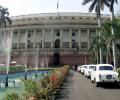
Opposition does not stall legislative agenda; Upper House passes two bills.

Addressing the members of the House, Singh said agriculture is a state subject but the Centre ignored it. "I find it very strange what the government of India wants to do," he said.
The monsoon session of Parliament is likely to begin in the third week of July and end by mid August.

Tax experts say one of the most dispute-prone proposals is making "fraudulent availing" of input tax credit (ITC), without an invoice or bill, a cognizable and non-bailable offence.

The S&P BSE Midcap and S&P BSE Smallcap indices hit a new lifetime high

Finance Minister Arun Jaitley accused Congress of setting a wrong precedence for future opposition parties by continuously disrupting Parliament.
Calibrated reopening of the economy by states as the number of fresh COVID-19 cases subside increased mobility and aided in a fast-paced increase in an index of business resumption last week, a Japanese brokerage said on Monday. The Nomura India Business Resumption Index rebounded to 76 for the week ended June 13, up from the preceding week's 67.9, a note from the brokerage said. The pre-pandemic value of the index is set at 100.

On the agenda during the session will be getting the Land Acquisition Bill, GST and other important bills passed.

Modi praised Tamil Nadu as a special place and lauded the Tamil language as eternal and its culture as global.

She resigned soon after her husband and SAD president Sukhbir Singh Badal strongly opposed the bills in Lok Sabha on Thursday night, claiming these proposed legislations will "destroy" the agriculture sector in Punjab, and announced that Harsimrat Kaur Badal will quit the government in protest against these three bills.

Naidu was an Akhil Bharatiya Vidyarthi Parishad activist during the Emergency and was arrested and jailed.

The indirect tax reform Goods and Services Tax is stuck in the Rajya Sabha.
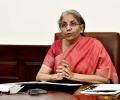
Expressing the government's commitment to continue with reforms, Finance Minister Nirmala Sitharaman on Thursday assured India Inc that it is ready to do everything required to revive and support economic growth hit by the COVID-19 pandemic. Stressing that there is a need to promote growth as it helps bring down poverty, she however said it would not be at the cost of inflation. RBI has been mandated to keep inflation at 4 per cent, with tolerance level of 2 per cent on either side.

The opposition, while not directly stalling Parliament, will insist all legislation goes to standing committees, delaying implementation.
The Auto Component Manufacturers Association of India on Wednesday sought reduction in GST rate to a uniform level of 18 per cent for the entire automobile industry to stimulate demand and help save around 10 lakh jobs, which are at risk due to prolonged slowdown in vehicle sales.

Experts have flagged issues regarding the levying of new cess/tax, especially those related to complications in administering the cess.

The surge in export, domestic demand and public spending in infrastructure projects might revive private investment during 2017-18.
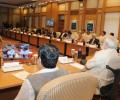
'Prime Minister Modi's message from Tuesday's meeting with industrialists was loud and clear: stand up India, stand by start-ups, take risk and invest,' says CII chief Sumit Mazumder.

Indian market has been plagued by negative sentiment and triggers
'It is entering growth territory on a month-on-month basis.'

FY16 saw the highest number of new product launches in a year from Maruti

The output of eight core sectors grew 8.9 per cent in June, mainly due to a low base effect and uptick in production of natural gas, steel, coal and electricity, official data showed on Friday. The eight infrastructure sectors of coal, crude oil, natural gas, refinery products, fertilisers, steel, cement and electricity had contracted by 12.4 per cent in June 2020 due to the lockdown restrictions imposed to control the spread of coronavirus infections. In May this year, these key sectors had recorded a growth of 16.3 per cent, while it was 60.9 per cent in April.

Prime Minister Modi highlighted the importance of public participation in a democracy and said that the definition of democracy could not be restricted only to elections and the governments.
 © 2026 Rediff.com - Advertise with us - Disclaimer - Privacy Policy - Sitemap - Feedback - About us - Terms of use - Grievances